
Based on verified court evidence and publicly documented assets, Sergei Georgievich Naumenko's net worth sits at a documented floor of approximately $45 to $50 million, anchored by his beneficial ownership of the 58.5-metre superyacht Phi, whose customs invoice exceeded €44 million in UK court filings. Accounting for his broader background in Ural-region property development, investment banking, and asset management, a plausible total range runs from roughly $50 million to $300 million, though that upper figure carries significant uncertainty due to the opacity of his private holdings. He does not appear on Forbes Russia's rich lists, placing him firmly in the category of very wealthy regional businessman rather than internationally-tracked oligarch. This estimate is current as of July 2026.
Sergei Naumenko Net Worth: Verified Estimate & Profile

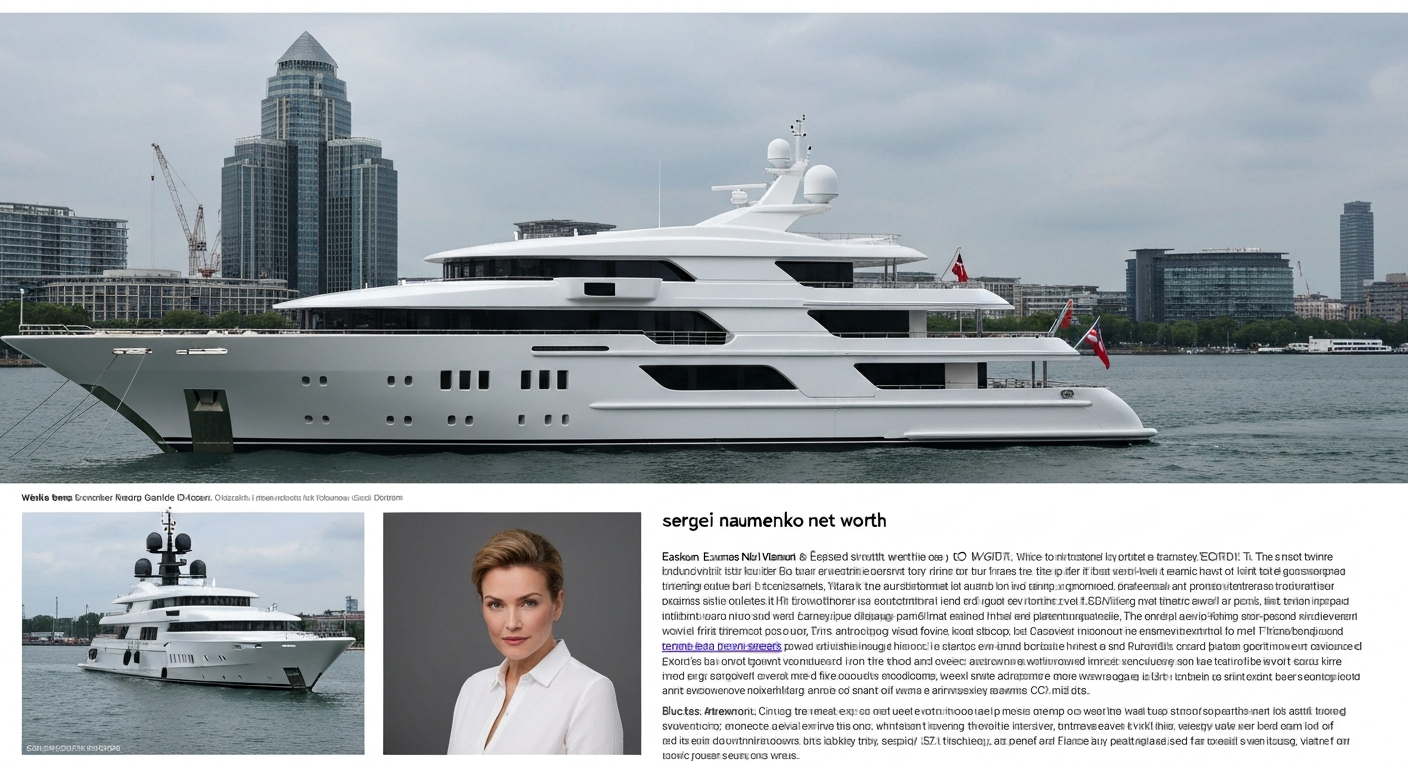
Net Worth Snapshot
| Metric | Value | Confidence |
|---|---|---|
| Documented asset floor | ~$45–50 million (Phi superyacht, court-admitted value) | High — court-filed invoice >€44m |
| Plausible total net worth range | $50 million – $300 million | Low to medium — private holdings unverified |
| Estimate reporting date | July 2026 | — |
| Forbes Russia listed? | No | Confirmed — court record notes absence |
| Sanctions status | Not designated (as of Supreme Court judgment) | High — court-confirmed |
The single most important data point in any Naumenko wealth estimate is the court-admitted customs invoice for the Phi, which places that vessel alone above €44 million. Everything else in the range is derived from circumstantial but credible evidence: multiple vessels, decades of business activity in high-margin sectors, and a lifestyle consistent with high-net-worth status. The width of the range reflects how little of his portfolio is independently auditable from the outside.
Who Is Sergei Naumenko? Identity and Biography
The individual at the center of this profile is Sergei Georgievich Naumenko (Russian: Сергей Георгиевич Науменко), a Russian citizen ordinarily resident in Yekaterinburg (Ekaterinburg), the largest city in Russia's Ural Federal District. His full patronymic is the critical disambiguation marker here, because 'Sergei Naumenko' is a genuinely common Slavic name with multiple distinct individuals appearing in Ukrainian open company registries, Russian municipal records, and sports databases. Example open registry entries for other individuals named Naumenko (OpenDataBot Ukraine), demonstrates frequency of name/identity collisions Example open registry entries for other individuals named Naumenko (OpenDataBot Ukraine) — demonstrates frequency of name/identity collisions. None of those share his documented legal identity as it appears in UK Supreme Court and Court of Appeal filings.
Court records describe his career arc in three phases. In the early 1990s, following Soviet dissolution, he became a senior operational manager and minority shareholder in an investment bank established in 1991, which he exited via a sale in 2012. Simultaneously, he held a regional management role and minority stake in an asset-management firm also founded in 1991. His third and most substantial business pillar was an original ownership position in a construction and development company privatised in the mid-1990s that went on to execute major projects across the Ural region. Russian company index records (including entries linked to a Sergei Georgievich Naumenko in Yekaterinburg, among them ООО 'СТРОЙ ЕК' / Stroy EK) corroborate the Supreme Court's description of his development background, though name-match risk means those records require cross-referencing against court filings before being treated as definitive.
Bloomberg and other international outlets, reporting on his UK court challenge in 2023, described him as a Russian property developer and food importer. He is not a figure who sought international media attention before the Phi detention brought him into public view, which is itself consistent with the profile of a regional wealth-holder whose fortune was built within Russia's post-Soviet privatisation and construction boom rather than through the globally-visible resource extraction deals that produced Russia's internationally-known oligarchs.
Income Streams and Business Interests
Naumenko's documented income sources fall into three broad categories: financial services, real estate development, and commodity trade. His stake in an investment bank active from 1991 to its 2012 sale would have generated both operating income over two decades and a one-time capital gain at exit, though the sale price is not publicly disclosed. His asset-management firm stake similarly provided ongoing fee income and likely a capital return. These two financial-sector positions placed him in the middle of Yekaterinburg's post-Soviet financial infrastructure during one of the most wealth-generating periods in Russian regional history.
The construction and development company is the probable engine of the bulk of his wealth. Ural-region commercial and residential development accelerated significantly through the 2000s and 2010s, and an original privatisation-era owner of a functioning construction entity would have accumulated substantial equity value over that period. Court submissions reference major Ural-region projects, though project names, contract values, and revenue figures are not itemised in publicly available judgment texts.
Bloomberg's 2023 reporting also identifies food importing as a business interest. This is consistent with the diversification pattern common among Russian regional businessmen who used capital from banking or development to move into import/distribution during Russia's consumption boom of the mid-2000s. No specific food-sector company names or revenue figures have been confirmed in international public databases as of the time of writing.
Documented Asset Inventory
The asset picture that emerges from court proceedings and yachting industry records is dominated by marine assets, with real estate and business equity as probable but unquantified additions.
Marine Assets
| Vessel | Type | Size | Builder | Delivered | Estimated Value | Evidence Source |
|---|---|---|---|---|---|---|
| Phi | Motor superyacht | 58.5 m | Royal Huisman (Netherlands) | 2021 | >€44m (court invoice); ~$45–50m market-equivalent | UK Supreme Court judgment, SuperYachtTimes |
| Phi Phantom | Support vessel | Not fully disclosed | Not publicly specified | Not publicly specified | Not independently valued in public sources | UK Supreme Court judgment |
| MY Aurelia | Motor yacht (previous ownership) | Not fully disclosed | Not publicly specified | Prior to Phi delivery | Not independently valued in public sources | UK Supreme Court judgment |
Legal title to Phi was held through Dalston Projects Ltd, a special-purpose vehicle incorporated in St Kitts and Nevis, with Prism Maritime Ltd, a Maltese entity, also named in proceedings. UK courts treated Mr Naumenko as the vessel's ultimate beneficial owner, with Ward and McKenzie providing consultancy evidence confirming that status. Royal Huisman is one of the world's most prestigious superyacht builders, and the Phi's build cost is consistent with independently reported industry figures of approximately £38 million to $50 million depending on currency and date of conversion. The vessel was detained at Canary Wharf, London, under the Russia (Sanctions) (EU Exit) Regulations 2019, meaning it remains effectively illiquid for its owner as of the latest available court record.
Real Estate and Business Equity
No specific real estate holdings have been publicly itemised in court proceedings or media coverage. Given his long residence in Yekaterinburg and his background in regional property development, it would be reasonable to expect residential and commercial real estate holdings in Russia, but these are entirely unverified from an international public-record standpoint. Similarly, his equity positions in the investment bank (exited 2012) and asset management firm have no publicly disclosed valuation. Private Russian company filings are not consistently accessible through major international commercial databases, and no audited group accounts linked to his development company have surfaced in the sources reviewed for this profile.
How the Estimate Was Built
Working from the outside in, the methodology here starts with the one hard number: the court-admitted customs invoice for Phi at above €44 million. That is the closest thing to an audited asset value available for any component of Naumenko's portfolio. From there, the estimate builds upward in two stages.
- Documented marine assets: Phi at approximately $45–50 million (using the court invoice as the base), plus the Phi Phantom support vessel and previously-owned MY Aurelia. Support vessels of that class typically run $5–15 million depending on specifications; these are included in the low end of the overall range but not added as a firm line item due to lack of independent valuation.
- Inferred business equity: decades of minority shareholding in an investment bank, an asset-management firm, and a privatisation-era construction company with major regional projects. Using conservative revenue multiples typical for private Russian mid-market firms (2x–5x EBITDA) applied to what would be plausible revenue for a regional development group, a retained equity value of $10 million to $250 million is theoretically supportable, but this is illustrative rather than evidenced. The wide band reflects genuine uncertainty.
- Confidence adjustment: given the complete absence of audited financials, public stock holdings, or property registers in accessible international databases, the upper end of the range carries a low confidence rating. The lower bound of $50 million is supported by court evidence and is the most defensible anchor.
The overall confidence level on the full range is low to medium. The floor estimate of approximately $45–50 million carries the highest confidence of any figure in this profile because it rests on a court-filed document rather than inference. The $300 million upper figure is included to capture realistic uncertainty, not as a probable midpoint. A midpoint estimate of roughly $100–$150 million is consistent with the available evidence but should be treated as illustrative.
Legal Record and Controversy
The defining legal event in Naumenko's public profile is the UK detention of the Phi at Canary Wharf under the Russia (Sanctions) (EU Exit) Regulations 2019, imposed in the context of post-invasion Russia sanctions measures. Dalston Projects Ltd, Naumenko, and Prism Maritime Ltd challenged the detention and lost at both the Court of Appeal (judgment issued 27 February 2024) and the UK Supreme Court. British court refuses to lift arrest on jets and yacht, The Moscow Times (27 Feb 2024) British court refuses to lift arrest on jets and yacht — The Moscow Times (27 Feb 2024). The courts upheld the Transport Secretary's power to detain the vessel as within the relevant statutory framework.
An important nuance from the judgment is that Naumenko was not personally designated (sanctioned) under the Russia Sanctions Regulations at the time of the proceedings, and the UK Foreign, Commonwealth and Development Office had specifically considered and rejected a designation in his case. The court's upholding of the yacht's detention therefore rested on the vessel's Russian-citizen-beneficial-ownership characteristics under the 2019 Regulations, not on a finding that Naumenko was himself subject to targeted sanctions. The Transport Secretary's public characterisation of him as a 'friend of Putin' was noted in the judgment and described as incorrect on the evidence, though this finding did not affect the legal outcome on detention.
From a valuation standpoint, the Phi's detention materially affects the realisable value of Naumenko's largest documented asset. A detained superyacht incurs ongoing maintenance and crew costs, cannot be charter-deployed or sold freely, and depreciates as a high-value luxury asset. The practical impact is that the $45–50 million court-value anchor is a nominal figure, not a currently realisable one. Press coverage of the case appeared in Bloomberg (July 2023), the Financial Times, The Moscow Times, and the specialist superyacht trade press including SuperYachtTimes.
What We Don't Know and Why That Matters
The gaps in this profile are substantial and largely structural rather than incidental. Russian private-company financial statements are not mandated to be disclosed in internationally accessible databases, and the holding structures Naumenko used for his largest known asset (a Caribbean SPV, a Maltese maritime entity) are designed precisely to minimise public visibility of beneficial ownership. This is not unusual for Russian high-net-worth individuals who accumulated wealth through regional business activity in the 1990s and 2000s, but it does mean that any wealth estimate relying primarily on public data will undercount.
- No audited financial statements for any company linked to Naumenko are available in major international commercial databases.
- The sale price of the investment bank stake (exited 2012) is not publicly disclosed.
- No real estate inventory has been published or confirmed by any court or registry source.
- The Phi Phantom's specifications and independent valuation have not been reported in open sources.
- Food importing operations described by Bloomberg have no associated company name, revenue, or ownership structure in the public record.
- Russian regional company filings linked by name to a Sergei Georgievich Naumenko in Yekaterinburg carry meaningful name-match risk and cannot be treated as confirmed without additional cross-referencing.
- The current status of the Phi detention (appeal outcomes, potential disposal orders, ongoing legal proceedings) may affect asset values post-July 2026 and is subject to change.
Each of these gaps pushes in the same direction: the publicly documented picture almost certainly understates total wealth. The documented floor is therefore best understood as a minimum, not a central estimate. For journalists or researchers who need a working figure, $50 million is defensible and cited; anything above that should be disclosed as an estimate with low evidential support.
Comparison, Context, and the Other Sergeis
Naumenko sits in a recognisable bracket of post-Soviet regional wealth: wealthy enough to commission a Royal Huisman superyacht and structure assets through offshore SPVs, but not visible on the international wealth lists that track Russia's top 100 or 200 fortunes. This positions him well above the broad Russian upper-middle class but well below the resource-extraction oligarchs whose wealth is measured in billions. In a regional context, he is a Ural-industrial-era beneficiary, analogous in structural terms to dozens of businessmen who leveraged the mid-1990s privatisation wave and the 2000s commodity-fuelled construction boom without ever achieving national media prominence.
It is also worth addressing the name-collision problem directly, because search traffic for 'Sergei Naumenko net worth' is almost certain to include people looking for other individuals. For example, searches for 'sergey kosenko mr thank you net worth' may surface unrelated profiles and should not be conflated with Sergei Georgievich Naumenko's documented holdings. For searches that may be targeting a different person, see the internal profile on Sergei Sergienko net worth for that distinct individual's reported assets. The court-documented subject of this profile is specifically Sergei Georgievich Naumenko of Yekaterinburg, connected to the Phi superyacht and Ural-region development. He is distinct from the multiple Ukrainian and Russian Naumenkos who appear in open company registries and sports records. For related coverage of a different individual, see our profile on Sergey Samsonenko net worth. This disambiguation matters practically: wealth estimates, litigation records, and business attributions from other 'Sergei Naumenko' individuals should not be applied to this profile.
Readers researching the broader landscape of post-Soviet wealth in this name-bracket may also encounter profiles of other regional businessmen with similar given names. The Eastern European Net Worth Guide covers several figures in this space, including Sergei Kosenko, Sergei Sergienko, and Sergey Samsonenko, each representing distinct industries and geographies within the former Soviet sphere. Serge Aliseenko and Sergey Sabalenka profiles on this site illustrate how wealth accumulation patterns differ across the entertainment, sports, and business sectors of the region. For a related profile with estimated figures and methodology, see the Serge Aliseenko net worth entry on this site. For a direct comparison, see the site's Sergey Sabalenka net worth profile.
| Name | Country/Region | Primary Sector | Approximate Wealth Tier | Internationally Listed? |
|---|---|---|---|---|
| Sergei Georgievich Naumenko | Russia (Ural region) | Property development, financial services | $50m–$300m (estimated) | No — not on Forbes Russia |
| Sergei Kosenko (profile) | Post-Soviet / Eastern Europe | See site profile | See site profile | See site profile |
| Sergei Sergienko (profile) | Post-Soviet / Eastern Europe | See site profile | See site profile | See site profile |
| Sergey Samsonenko (profile) | Post-Soviet / Eastern Europe | See site profile | See site profile | See site profile |
| Serge Aliseenko (profile) | Post-Soviet / Eastern Europe | See site profile | See site profile | See site profile |
Within the superyacht ownership subset of Russian wealth, Naumenko's Phi at 58.5 metres places him in company with mid-tier Russian high-net-worth individuals rather than the ultra-high-net-worth 80-to-180-metre fleet associated with sanctioned oligarchs. This is consistent with a total net worth in the tens to low hundreds of millions of dollars range, and with the Supreme Court's implicit framing of him as a wealthy private individual rather than a sanctioned public figure. The yacht was his largest individually traceable asset and, as of mid-2026, also his most legally constrained one.
FAQ
What is the concise net-worth snapshot for Sergei Naumenko?
Estimated net worth: plausible range $50 million–$300 million (nominal). Documented-asset floor: roughly $45–50 million (the Royal Huisman superyacht Phi, invoice/court evidence >€44m). Confidence level: low-to-medium due to lack of audited private-company financials and offshore structures. Sources: UK Supreme Court judgment (Phi invoice/case material) https://supremecourt.uk/uploads/uksc_2024_0045_0055_judgment_b490db4480.pdf and corroborating reporting (Bloomberg) https://www.bloomberg.com/news/articles/2023-07-13/russian-tycoon-says-uk-seized-his-canary-wharf-superyacht-just-to-look-tough
Who exactly is Sergei Naumenko (identity verification and short biography)?
Identified in UK court records as Sergei Georgievich Naumenko (Сергeй Георгиевич Науменко), a Russian citizen ordinarily resident in Yekaterinburg (Ekaterinburg). Court material and filings describe him as a regional property developer with prior minority shareholdings and managerial roles in a bank and an asset-management firm dating from the 1990s; reporting also references involvement in import/commodity activity. Primary legal identifier and residency are from the UK Supreme Court case material: https://supremecourt.uk/uploads/uksc_2024_0045_0055_judgment_b490db4480.pdf and case listing https://jcpc.uk/cases/uksc-2024-0055
What are the known and verifiable sources of Naumenko's income and business interests?
Documented/described sources (from court materials and regional registries): (1) property development and construction projects in the Ural region (privatised construction company interests); (2) minority shareholdings and senior operational roles in an investment bank (established c.1991, sold 2012) and in an asset-management firm (founded c.1991); (3) reported trading/import activities (media references). Court background summarising these activities: https://jcpc.uk/cases/uksc-2024-0055 and supporting judgment https://supremecourt.uk/uploads/uksc_2024_0045_0055_judgment_b490db4480.pdf. Public corporate dossiers (example: ООО “СТРОЙ ЕК”) corroborate regional construction links: https://companies.rbc.ru/id/1126686009064-ooo-stroj-ek/
What high-value assets are documented as belonging to Naumenko?
Documented assets in public/legal records: (1) Superyacht 'Phi' (58.5 m, Royal Huisman, delivered 2021) — beneficial ownership attributed to Sergei Georgievich Naumenko in UK proceedings; shipyard invoice used in customs evidence >€44 million (UK Supreme Court judgment) https://supremecourt.uk/uploads/uksc_2024_0045_0055_judgment_b490db4480.pdf. (2) Court material also references ownership or control of other yachts/support vessels (e.g., Phi Phantom, previously MY Aurelia) — industry coverage notes these vessels and approximate market/build costs: https://www.superyachttimes.com/yacht-news/seized-yacht-phi-supreme-court-appeal. (3) Regional private-company holdings in construction/development and minority stakes in financial firms (corporate registries, not accompanied by public audited accounts) — example registry: https://companies.rbc.ru/id/1126686009064-ooo-stroj-ek/
What assets or holdings remain unverified or likely private/offshore?
Unverified or opaque items: (1) equity stakes in private development firms and banks — no public audited group financial statements or stock-exchange filings attributable to Naumenko were located in major databases; (2) offshore SPVs used for yacht ownership (Dalston Projects Ltd, Prism Maritime Ltd) point to offshore structuring that obscures direct corporate records; (3) other real estate, art, vehicles, investment portfolios or bank accounts — not disclosed in court evidence and not publicly searchable. Court filings confirm SPV structures: https://jcpc.uk/cases/uksc-2024-0055 and judgment https://supremecourt.uk/uploads/uksc_2024_0045_0055_judgment_b490db4480.pdf
How was the net-worth estimate derived (methodology) and what is the confidence level?
Methodology: (A) documented-asset floor = sum of verifiable high-value assets admitted in evidence (Phi invoice >€44m → ~$45–50m); (B) add probable privately held equity value using qualitative adjustment (based on court descriptions of longstanding development, banking and asset-management interests) but without audited financials or market valuations; (C) apply a wide uncertainty band to reflect opacity of private holdings and offshore structures. Resulting estimate: $50M–$300M (low-to-medium confidence). Rationale and evidence are in the UK Supreme Court judgment and supporting reporting: https://supremecourt.uk/uploads/uksc_2024_0045_0055_judgment_b490db4480.pdf; Bloomberg: https://www.bloomberg.com/news/articles/2023-07-13/russian-tycoon-says-uk-seized-his-canary-wharf-superyacht-just-to-look-tough